A Journey Through the American Medical System, part 1
[prostate insurance In 2009, author and journalist Jeff Jarvis began using Twitter to share his living with a prostate cancer diagnosis. He led people on his arc through treatment and recovery. His micro-blogging was described by some as ‘radical oversharing’. For others, his narrative revealed a medical reality for many men in the U.S. For many (not just men), it reduced the mystery and stigma of cancer battles and recovery.
I might be starting a similar journey, and I’m going to write about it.
My experience will not be the same as Jeff’s. I’m not starting from the same point (the c-word is merely a possibility at this point), and my experience so far has been distinctly different. Also, there’s no audience that’s already paying attention to me; in fact, I’m not sure who I’m writing for other than myself. If others read this and get some insight navigating health and the American Medical System, then the time and effort I put into creating this will be worth it.
Let’s just be careful
In spring of 2026, I made a decision to take a different approach to my personal health. Up until then, I’d been only visiting doctors by necessity. Now, I was choosing to be proactive about some lingering health issues like high cholesterol, high blood pressure, some recurring (chronic?) body pain, and stress. My new approach was to lean in and take advantage of modern medical technology to improve my quality and length of life. I’m lucky to have a thoughtful primary care physician (Dr. Hany Fouad at Dignity Health) who supported this pivot.
In March, I had a checkup following a standard blood test. Dr. Fouad noted that my PSA levels were a little high and creeping up while other blood chemistry factors were edging down. “Better be safe and look at this,” he said.
I took the blood test again in April and the numbers were still a bit elevated. After a standard digital prostate exam that seemed normal1, Dr. Fouad suggested I get an MRI of my prostate to get a better sense of what’s happening in there. I scheduled the MRI (my first ever). It was easy but not quick. This was mid-July.
Biopsy Salesman
Dr. Fouad sent me to consult on the MRI with a urologist, Dr. Michael Poon at Community Memorial Health. I met with Dr. Poon on August 11th. Because I didn’t know anything about him, I was already thinking about second opinions.
My intimate experiences with the American Medical System has been limited to an outpatient hernia operation, an inpatient treatment for a wound infected with MRSA, and a vasectomy done by a very colorful doctor. I’ve been witness to my wife’s relationship with doctors (which has been more consistent than mine), and I’ve watched from afar while my dad has gone through some major medical incidents including a debilitating West Nile Virus infection and three types of cancer (thyroid, prostate, and something in his chest). He got treatment for West Nile at the Mayo Clinic in Rochester, MN, and that treatment led to the discovery of a cancer that they also treated (by removing). He and my mom couldn’t say enough good things about their experience at Mayo. Knowledgeable and skilled doctors, top-grade care, clear processes, all delivered with a clockwork efficiency of a fine-tuned factory.
I wanted that.
The American Medical System is not built to deliver Mayo clinic quality for everyone. The American Medical System is Big Business, and it’s selling its wares to its customers. Blood tests, Xrays, MRIs, biopsies, appointments with specialists. These all have a veneer of medical magic, but they also generate income for those inside the system. If you want quality care, you have to work to find it, and you must be prepared to reject a doctor if you think they are compromised by something that’s not in your interest. It’s not personal. It’s your health. So you must be brutal in the process you use to find the right doctor.
I met with Dr. Poon on August 11. That meeting didn’t go great. Dr. Poon had the aura of belonging to a fraternity, and when he learned I was a mathematics professor, he laughed as boasted that he cheated in college Calculus using a roommate’s girlfriend’s homework. I can’t remember if that was before or after he told me that the MRI showed some abnormalities (or lesions) on my prostate. Those lesions merited a biopsy.
After he said there was a 30%-50% chance they would turn out to be cancerous, he tried to shuffle me into an appointment with his clinic for the ultrasound-guided biopsy in a couple weeks. I demurred, saying I’d have to talk with my wife first.
Was this me saying that I didn’t know what to do about my health at that point? No. I didn’t doubt that I’d need a biopsy. Was this me saying I couldn’t make a decision about my healthcare without my wife’s input? No. It was me having a gut feeling that Dr. Poon was a biopsy salesman who was positioning me to open a spigot of insurance money to pour into his clinic. I was about to become a valuable customer. Do physicians get bonuses for lining up patients like me? Do they have biopsy quotas they need to meet?
After the consultation and before I even made it to my car, I decided to find a different urologist.
(Fast forward to November 2026. I’m in an exam room with my primary care physician, Dr. Fouad. As I update him on my prostate journey, I share that I really don’t like Dr. Poon. “You’re not the first,” he replied drily.2)
How does a person like me find an excellent doctor? The answer almost always lies in a personal and professional network of people. I racked my brain for friends and acquaintances who could give me advice on good doctors. How could I find the best urologist in the area that’s covered by my insurance? The insurance company has a web site that will tell me who is in my network, but the site gives very little information that would help a person choose a doctor for the right reasons.
I have a friendly neighbor who is a UCLA-trained cardiologist. I texted him on August 10th.
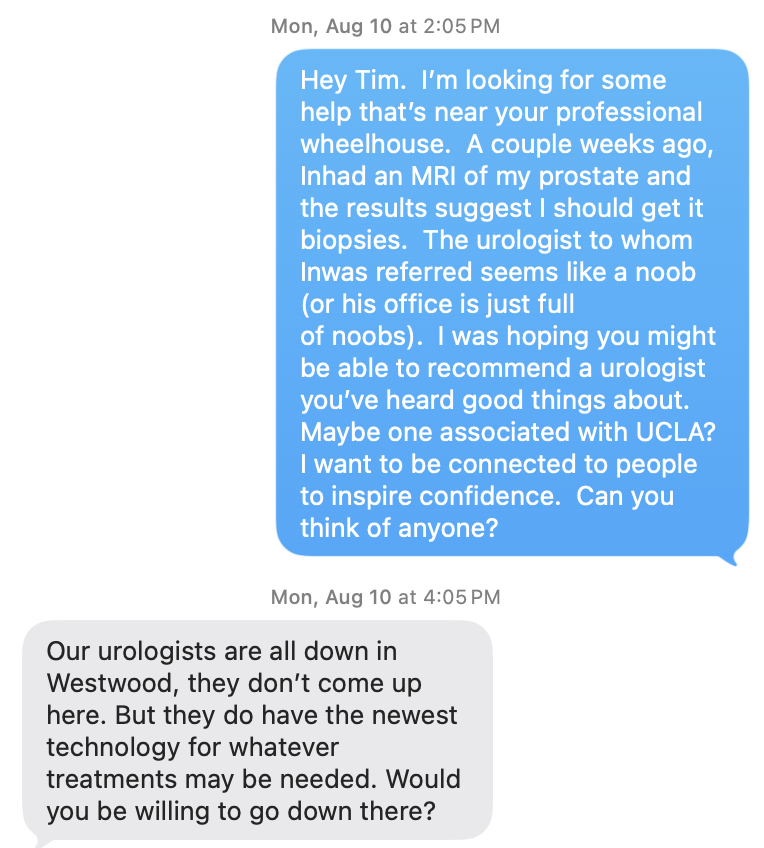
He recommended two urologists he knew about at UCLA. I called the UCLA urology department and learned that neither were taking patients at the time. Bummer.
The next post is available.
-
There’s a stand-up joke here that I’m working on. It has something to do with the American male’s distaste for the idea of getting an anal digital exam until he actually has one and finds out it’s not so bad. And then he experiences distaste for the idea that it wasn’t so bad. This still needs workshopping. ↩
-
Then why does Dr. Fouad refer patients to Dr. Poon? Could it be that Dr. Poon is in the same medical organization as Dr. Fouad, and there’s an expectation that Dr. Fouad refer patients to Dr. Poon for business reasons? This is the way the American Medical System works. So we patients need to be ever vigilant and exercise complete control over our care decisions. Caveat emptor. ↩